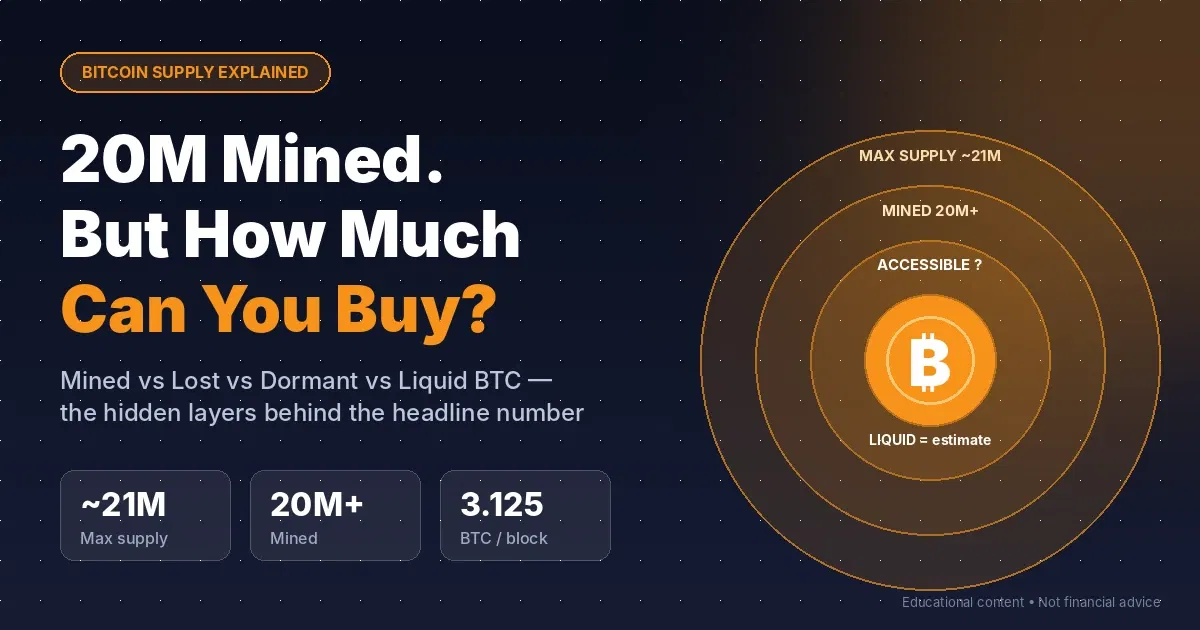
Learn how to read bitcoin supply data, avoid six common mistakes and match each metric to your trading instrument with confidence.
Risk warning: trading forex and CFDs is risky, and bonuses come with conditions. Never trade money you cannot afford to lose.
Why Bitcoin Supply Data Is So Often Misread
"Bitcoin supply on exchanges hits multi-year low!" "Millions of BTC lost forever — the real float is tiny!" "Only 1 million bitcoin left to mine!"
If you trade or invest in crypto, you have seen headlines like these. Many of them are technically true. Many are also wildly misleading — not because the data is fake, but because readers assume every supply number measures the same thing.
Since Bitcoin passed 20 million issued coins on 9 March 2026, supply stories have become louder than ever. This guide gives you a simple framework to cut through the noise, plus six mistakes that quietly ruin trading decisions.
Key Facts: A 30-Second Refresher
- Max supply: ~21 million BTC, enforced by the protocol.
- Issued / circulating supply: 20 million+ BTC — every coin mined so far, including lost ones.
- Current block subsidy: 3.125 BTC per block since the April 2024 halving.
- Halving cycle: every 210,000 blocks, roughly every four years.
- Final issuance: expected to approach the cap around 2140.
- Lost, dormant, illiquid and liquid supply: all estimates, built on different models.
The 5-Step Framework for Reading Bitcoin Supply Data
Step 1 — Ask: "What exactly is this number measuring?"
Before you react to any chart, identify the metric:
| If the figure is… | It tells you… |
|---|---|
| Circulating / issued supply | Total BTC created to date |
| Exchange balance | BTC in wallets tagged as exchange-owned |
| Short-term holder supply | Coins that moved recently |
| Long-term holder supply | Coins held beyond a chosen time threshold |
| Liquid supply / free float | A model's estimate of tradable BTC |
These numbers are not interchangeable. Mixing them up is the root of most bad supply takes.
Step 2 — Separate the stock from the flow
- Stock = the accumulated pile of issued BTC (20M+).
- Flow = new BTC entering that pile each block (3.125 BTC today).
A halving cuts the flow in half. It does not remove a single coin from anyone's wallet. Traders who confuse the two often overestimate a halving's immediate impact on available supply.
Step 3 — Watch for overlapping categories
Lost coins are usually also dormant and illiquid. Long-term holders may be dormant and illiquid while keeping full access to their coins.
If someone subtracts all of these separately from circulating supply, they have likely double- or triple-counted. The "real float" they quote is then implausibly low.
Step 4 — Put supply next to demand
Scarcity is only half the equation. A thin market float can make price more sensitive to demand shifts, but it does not tell you which direction price moves next. Long-term holders can start selling. Demand can fade even while issuance stays low.
Serious analysis pairs supply with:
- 📈 spot market demand and liquidity
- 🏦 Bitcoin ETF creations and redemptions
- 📊 derivatives positioning (futures, funding rates, open interest)
- 🌍 macroeconomic conditions — rates, dollar strength, risk appetite
- 💬 overall market sentiment
Step 5 — Match the metric to your instrument
This is the step most guides skip.
- Holding real BTC? Custody, private-key security and transferability directly affect your coins. Supply concepts like "lost" become very personal.
- Trading Bitcoin CFDs? You do not own the underlying coins. Supply statistics still matter because they influence the underlying BTC market and price. But they do not reflect the number of CFD contracts available or the size of your position.
CFD traders should also compare trading costs. For one example, see Headway Reduces Bitcoin Trading Commissions by 65%, and always read the broker's own terms.
6 Mistakes That Trip Up Bitcoin Traders
❌ Mistake 1: Treating circulating supply as "inventory for sale"
The 20 million figure is a historical tally of issued coins. It says nothing about how much BTC sellers are offering right now, at today's prices.
❌ Mistake 2: Assuming every old wallet is lost
A wallet untouched for a decade might belong to a disciplined long-term holder. Inactivity alone never proves loss. Some of the most famous "dormant" coins have suddenly woken up over the years.
❌ Mistake 3: Subtracting overlapping estimates
Lost, dormant and illiquid coins share members. Subtract each one independently and you will invent a supply shortage that does not exist.
❌ Mistake 4: Thinking exchange balances equal total available supply
Bitcoin trades through brokers, custodians, OTC desks, ETFs and other structures. Exchange wallets are just one window into the market. Falling exchange reserves can reflect coins moving into custody products rather than vanishing from trade.
❌ Mistake 5: Believing scarcity guarantees a price rise
Scarcity shapes the supply side. Price is still the meeting point of supply and demand. Plenty of periods have seen Bitcoin fall despite a fixed, shrinking issuance schedule.
❌ Mistake 6: Using a number without a date
Issued supply grows with every block. Liquid, illiquid and exchange-balance estimates can shift even faster. A supply stat without a timestamp may already be stale.
Your Pre-Trade Supply Data Checklist
Before using any "available supply" or "liquid supply" figure, check:
- Which categories are excluded? (lost, dormant, strategic, burned…)
- What inactivity threshold is used? (1 year? 5 years? 7?)
- Are addresses grouped into entities? And how?
- How are exchange and custodian wallets treated?
- When was it measured, and how often is it updated?
If a source cannot answer these questions, treat its number with caution.
Quick FAQ
How many bitcoins have been mined?
Bitcoin crossed 20 million issued BTC on 9 March 2026, and more has been mined since. For an exact live figure, check a dated blockchain-data source.
How many bitcoins are left to mine?
Fewer than roughly 1 million. They are released gradually until around 2140.
Is dormant Bitcoin the same as lost Bitcoin?
No. Dormant coins simply have not moved for a set period, and their owners may still have full access. No one knows precisely how many bitcoins are permanently lost. Long-term inactivity cannot reliably separate a lost wallet from a patient holder.
Does a halving reduce the coins already in circulation?
No. It only halves the rate of new issuance.
Final Word
Bitcoin's supply is one of the most transparent in finance, because every coin's creation is recorded publicly. Yet the key question for traders — how much BTC is genuinely available to trade? — has no single official answer.
The edge does not come from finding the "right" number. It comes from knowing what each number really measures, refusing to stack overlapping estimates, and always weighing supply against demand. Then you can read the next viral "supply shock" headline with a sharper eye.
Thinking of using a bonus to fund crypto CFD trading? Read the $30 No Deposit Free Forex Bonus Guide or FXBITI $30 Welcome Bonus Offer How to Get Started. Check the broker's terms for the exact withdrawal conditions first.
Risk disclaimer: This content is educational and not investment advice. CFDs are complex instruments with a high risk of losing money rapidly due to leverage. Trading forex/CFDs is risky and bonuses come with conditions. Only trade with funds you can afford to lose.