After a forex bonus, learn how to choose the right forex broker by comparing regulation, fees, platform features, and withdrawal rules.
From Free Bonus to the Right Broker A Practical Checklist for Your Next Trading Account
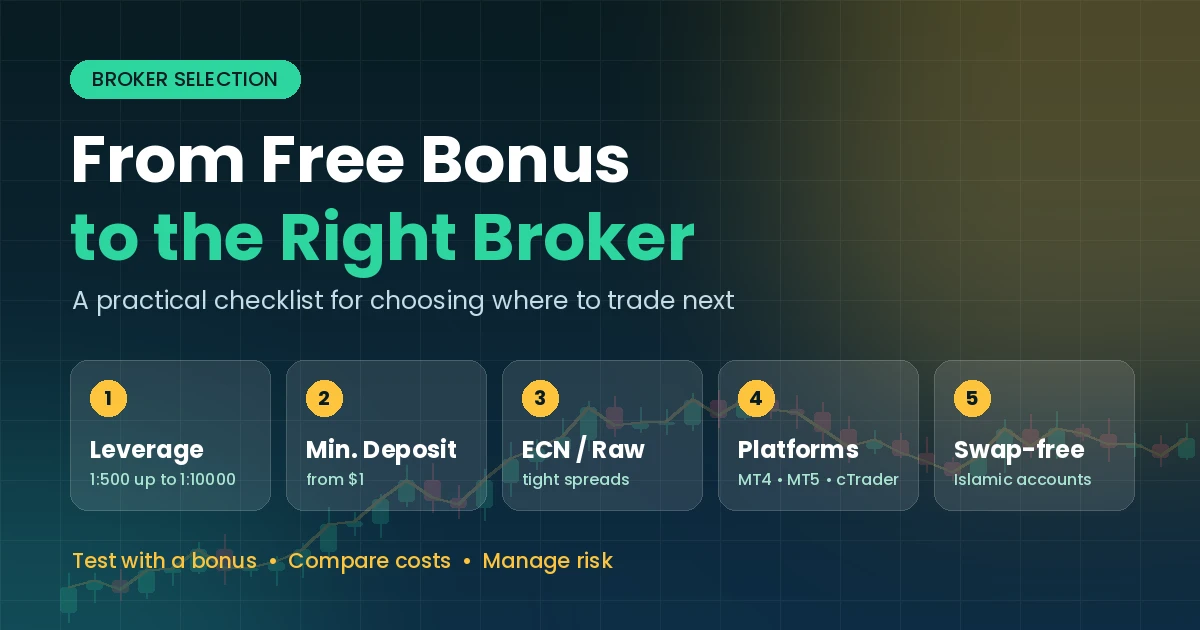
Checklist for choosing a forex broker after a no deposit bonus: leverage, minimum deposit, ECN, platforms and swap-free accounts
A no deposit bonus is a fantastic way to get your feet wet. You get free capital, a feel for live execution and a sense of how a broker treats its clients. But sooner or later the bonus runs out — and you face a much bigger decision: where should you put your own money?
The answer isn't simply "the broker that gave me the bonus." The best broker for you depends on how you trade, how much you want to start with, which platform you prefer and even your personal beliefs about interest. This guide walks through the five factors that matter most, with real broker data to help you compare.
Step Zero: Use Your Bonus as an Audition
Before comparing spec sheets, review what your bonus account already taught you. Ask yourself:
- Did orders fill quickly, or did you notice delays and slippage around news releases?
- Were spreads stable, or did they balloon at certain hours?
- How did support respond when you asked a question?
- How smooth was the withdrawal, if you got that far?
If a broker passed this audition, it earns a place on your shortlist. If not, you've lost nothing — and gained valuable information. Now let's look at the five factors that separate a good broker from a great one for you.
Factor 1: Leverage — Power That Cuts Both Ways
What Leverage Really Means
Leverage lets you control a position much larger than your account balance by effectively borrowing from the broker. With 1:10 leverage, $100 in your account controls a $1,000 position. With 1:30, a $1,000 deposit controls $30,000 worth of currency.
That magnification is why leverage is so popular among retail traders — but it applies equally to losses. A move that would cost you 1% unleveraged can cost you 30% at 1:30.
How Margin Fits In
Brokers express leverage requirements as margin — the percentage of the full position size you must hold as collateral. A 2% margin requirement equals 1:50 leverage; a 1% requirement equals 1:100.
Why Leverage Limits Vary So Much
Strictly regulated regions such as Europe, the United States and Australia cap retail leverage at low levels — for example, around 1:30 on major currency pairs and lower still on gold or indices. Internationally, many brokers offer 1:500, 1:1000 or more. Leverage can also vary by instrument: forex, metals, energies, indices and stock CFDs often carry different limits.
Brokers With the Highest Leverage
| Broker | Max Leverage | Min. Deposit | ECN Account From |
|---|---|---|---|
| Exness | Up to 1:10000 | $200 | $2,000 |
| Headway | Up to 1:10000 | $1 | $100 |
| JustMarkets | Up to 1:3000 | $1 | $100 |
| FBS | Up to 1:3000 | $1 | — |
| AMarkets | Up to 1:3000 | $100 | $200 |
| Alpari | Up to 1:3000 | $30 | $500 |
| FxGlory | Up to 1:3000 | $1 | — |
| RoboForex | Up to 1:2000 | $10 | $10 |
| FreshForex | Up to 1:2000 | $10 | $10 |
| HFM | Up to 1:2000 | n/a | — |
Your Safety Net: Negative Balance Protection
High leverage makes one feature essential: negative balance protection. Brokers that offer it use an automatic stop-out — when your margin level falls below a set threshold, open positions are closed so your losses can't exceed your account balance. Brokers such as XM and xChief highlight this protection.
Rule of thumb: Just because a broker offers 1:2000 doesn't mean you should use it. Pick a broker whose limits fit your strategy, then trade with far less than the maximum.
Factor 2: Minimum Deposit — Start Small, Learn Fast
After a bonus account, many traders want to move to real money gradually. A low minimum deposit makes that easy: you can trade live with a small stake while your emotional discipline catches up with your technical skills.
Brokers differ here because their business models differ. Some serve a large base of retail traders and keep entry costs near zero. Others focus on high-net-worth clients and set higher minimums.
Brokers With the Lowest Entry Points
| Broker | Min. Deposit | Max Leverage | Highlights |
|---|---|---|---|
| JustMarkets | $1 | 1:3000 | Low spreads, copy trading, regional payments |
| FBS | $1 | 1:3000 | Diverse accounts, copy trading app |
| BlackBull Markets | $1 | 1:500 | ECN from $1, all four major platforms |
| Headway | $1 | 1:10000 | Local payment options, swap-free available |
| FXOpen | $1 | 1:500 | ECN pioneer, PAMM technology |
| Admirals | $1 | 1:1000 | Huge range of stocks, ETFs and CFDs |
| InstaForex | $1 | 1:1000 | Contests, copy trading |
| XM | $5 | 1:1000 | No requotes, negative balance protection |
| Pepperstone | $10 | 1:500 | Institutional-grade spreads, multiple platforms |
| Deriv | $10 | 1:1000 | 24/7 synthetic indices, weekend trading |
Factor 3: Account Type — Standard vs. ECN
This choice has a direct impact on your trading costs — and therefore your profitability.
Standard (Market Maker / STP) Accounts
These usually charge no commission but have wider spreads. The broker may take the other side of your trade. They suit beginners and swing traders who prefer simple cost calculations.
ECN (Electronic Communications Network) Accounts
ECN technologyconnects you directly to liquidity providers — banks, prime brokers and financial institutions. Your orders are matched anonymously within the network rather than handled by a dealing desk, which removes the conflict of interest found with market makers. ECN brokers are also known as No Dealing Desk (NDD) brokers.
You typically get the raw market spread (often close to 0.0 pips on EUR/USD) plus a fixed commission per lot. The total cost per trade is usually lower than on a standard account.
Why traders choose ECN:
- Tight, market-driven spreads and deep liquidity
- No requotes and fast execution with low slippage
- Anonymous order placement
- Scalping, news trading and hedging allowed
- Greater stability during volatile news events
The trade-offs:
- Higher minimum deposits on some brokers
- Larger minimum trade sizes
- Platforms can feel less beginner-friendly
- Generally lower leverage
- Stop-loss execution at the exact price is never guaranteed
Most Accessible ECN Accounts
| Broker | ECN From | Max Leverage | Platforms |
|---|---|---|---|
| BlackBull Markets | $1 | 1:500 | TradingView, cTrader, MT4, MT5 |
| RoboForex | $10 | 1:2000 | MT4, MT5 |
| FreshForex | $10 | 1:2000 | MT4, MT5 |
| Pepperstone | $10 | 1:500 | TradingView, cTrader, MT4, MT5 |
| JustMarkets | $100 | 1:3000 | MT4, MT5 |
| Tickmill | $100 | 1:500 | TradingView, MT4, MT5 |
| FP Trading | $100 | 1:500 | cTrader, MT4, MT5 |
| FXOpen | $100 | 1:500 | TradingView, MT4, MT5 |
| Vantage | $500 | 1:500 | TradingView, MT4, MT5 |
Factor 4: Trading Platform — Match the Tool to Your Style
Your platform is where you'll spend every trading hour, so choose it as carefully as the broker itself.
MetaTrader 4 (MT4): The Veteran
MT4 has been the industry workhorse for many years. Its greatest strength is its ecosystem: the overwhelming majority of Expert Advisors (trading robots) and custom indicators were written in its MQL4 language. It is lightweight, stable and runs well on older computers. The downside is a dated interface and less intuitive charting.
MetaTrader 5 (MT5): The Upgrade
MT5 is faster, supports multi-asset trading and includes a far superior Strategy Tester for backtesting robots. If you don't depend on legacy MQL4 robots, MT5 is the more future-proof option.
cTrader: Built for Manual and Scalping Traders
cTrader has a sleek, modern interface designed natively for ECN trading. Standout features include Depth of Market (DOM) for real-time liquidity, one-click advanced order management such as partial take-profit, and cloud sync so your workspace follows you between computers.
TradingView: The Chartist's Choice
TradingView offers the best charting tools available, a large social community and its own Pine Script language. Some brokers now integrate it directly, so you can place trades straight from the charts. It is fully web-based and very responsive.
Platform Comparison
| Criterion | MT4 | MT5 | cTrader | TradingView |
|---|---|---|---|---|
| Interface | Dated | Improved | Modern | Excellent |
| Automated trading | Industry leader (MQL4) | Strong (MQL5) | Very good (C#) | Limited (Pine Script) |
| Execution | Reliable | Fast | Very fast (ECN) | Depends on broker |
| Scalping | Average | Good | Excellent | Good |
| Installation | Download | Download | Desktop or web | Web / app |
Brokers supporting all four platforms include BlackBull Markets, Pepperstone, IC Markets and FxPro — useful if you want the flexibility to switch tools later.
Factor 5: Swap-Free (Islamic) Accounts
When you hold a position overnight, brokers normally charge or pay a swap (rollover interest). Swap-free accounts — often called Islamic accounts — remove this interest to comply with Islamic finance principles, which prohibit charging interest.
Instead of swaps, the broker usually applies a commission or an adjusted fee structure. These accounts aren't only for Muslim traders — anyone who wants to avoid overnight rollover costs can benefit. However, conditions vary widely; some brokers limit the instruments or holding periods available on swap-free accounts.
Brokers offering swap-free accounts include: Exness, RoboForex, IC Markets, JustMarkets, FBS, Tickmill, XM, FxPro, AvaTrade, HFM, Plexytrade, AMarkets, IC Trading, Vantage, Alpari, FreshForex, InstaForex and xChief.
Putting It All Together: Match a Broker to Your Profile
| If You Are... | Prioritize | Brokers Worth Comparing |
|---|---|---|
| A beginner moving from a bonus account | Low deposit, simple accounts, education | XM, FBS, JustMarkets, AvaTrade |
| A scalper or day trader | ECN, raw spreads, fast execution, cTrader | BlackBull, Pepperstone, Tickmill, FXOpen |
| An algorithmic trader | MT4/MT5, VPS, strategy tester | RoboForex, AMarkets, IC Trading, FxPro |
| A high-leverage trader | Flexible leverage with negative balance protection | Exness, Headway, FreshForex, HFM |
| Seeking interest-free trading | Swap-free accounts | Exness, XM, Tickmill, Vantage |
| Wanting 24/7 markets | Synthetic indices, weekend trading | Deriv |
| Preferring social or copy trading | Built-in copy-trading tools | LiteFinance, InstaForex, FBS, HFM |
How Professional Rankings Evaluate Brokers
Independent comparison sites typically score brokers on four main pillars — and you can use the same lens:
- Reputation — a consensus of expert reviews, independent tests and real user feedback.
- All-in trading cost — spreads plus commissions, especially on major pairs like EUR/USD.
- Execution speed — orders filled quickly at the requested price.
- Market range — access to forex, indices, commodities and crypto from one account.
Frequently Asked Questions
Should I stay with the broker that gave me a no deposit bonus? Only if it passed your "audition" — fast execution, fair spreads, helpful support and a smooth withdrawal process. A bonus is a sampling tool, not a commitment.
Is higher leverage always better? No. Higher leverage increases both potential gains and potential losses. Choose a broker whose limits suit your strategy, and use well below the maximum.
What is the cheapest way to start trading with real money? Several brokers accept deposits from as little as $1, including JustMarkets, FBS, BlackBull Markets, Headway, FXOpen and Admirals.
Is an ECN account suitable for beginners? It can be, especially with brokers offering low ECN minimums. However, commission-based pricing and professional-style platforms can take some getting used to.
MT4 or MT5 — which should I pick? Choose MT4 if you rely on existing MQL4 robots or indicators. Otherwise, MT5 is faster, supports more assets and has a better backtesting engine.
Are swap-free accounts free of all costs? No. They remove overnight interest, but brokers usually replace it with a commission or other fee. Always compare the total cost.
Final Word
A free bonus opens the door — but your choice of broker decides how far you'll go. Use your bonus experience as real evidence, then weigh leverage, minimum deposit, account type, platform and swap policy against your own trading style. The "best" broker isn't the one with the flashiest promotion; it's the one whose conditions quietly support your strategy, trade after trade.
Risk Warning: Trading forex and CFDs on margin carries a high level of risk and can result in the loss of your entire investment. Leverage magnifies both gains and losses. Broker conditions such as leverage, minimum deposits and platforms change over time and differ by jurisdiction; many offers are not available in the EEA, United States, Canada, Australia and other regulated regions. Always verify current terms with the broker. This article is for educational purposes only and does not constitute financial advice.