No Deposit
$30 Free Welcome Bonus, 120% Forex Bonus
4.60/ 5
Open AccountRead RoboForex review →20 brokers ranked by our team. Compare bonus offers and ratings, filter by bonus type, then open an account in one click.
$30 Free Welcome Bonus, 120% Forex Bonus

Get $140 Level Up Forex No Deposit Bonus

$150 Forex No Deposit Bonus on Headway


No broker matches your search. Try another name or filter.
Bonus terms are set by each broker and can change at any time. Always read the full terms on the broker's website before you deposit. Some links are affiliate links.
Free trading capital from brokers, no deposit required. Register, verify your account and start trading live. These are the newest offers added to FxBonusOffer.
Forex No Deposit Bonus
Forex No Deposit Bonus
Forex No Deposit Bonus
Forex No Deposit Bonus
No Deposit Welcome Bonus
KYC Verification Bonus
Forex No Deposit Bonus
No Deposit Trading Credit
No Deposit Welcome Bonus
Open a new live account through the offer page with your real details.
Upload ID and proof of address. Most bonuses arrive only after KYC.
Request the bonus in your client area if it is not added automatically.
Meet the volume rule within the time limit, then withdraw your profit.
One bonus per person. Offers may not be available in every country and can end without notice. Always read the full terms on the broker's website before you claim.
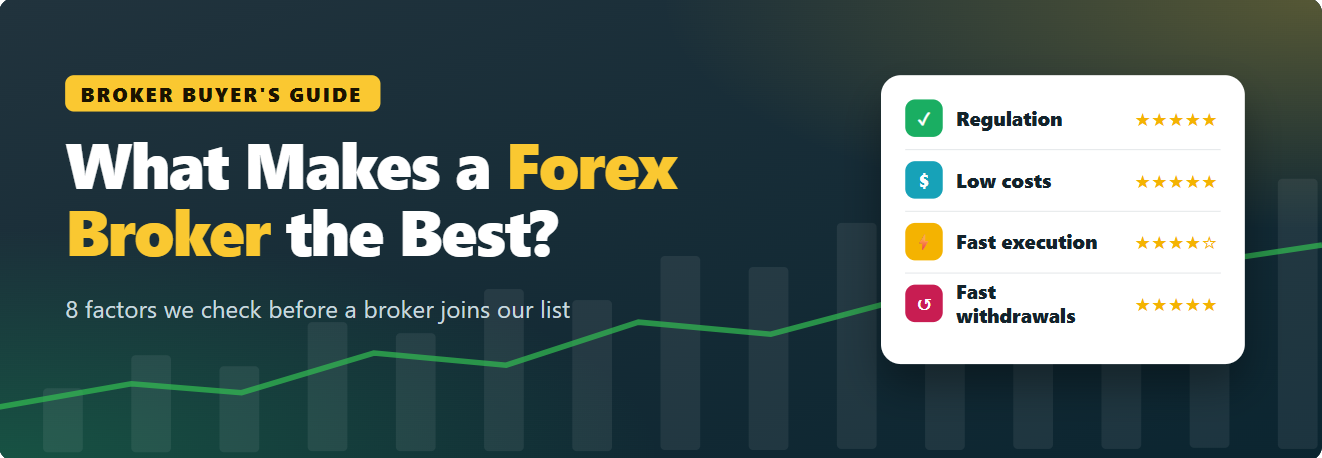
Choosing a forex broker is the first real trading decision you make, and it affects every trade after it. Your broker holds your money, prices your orders, sets your costs and decides how fast you get paid when you withdraw. A good broker quietly does all of this well. A poor one can turn a winning strategy into a losing account through hidden fees, slow execution or blocked withdrawals.
There is no single "best" broker for everyone. A scalper who trades 50 times a day needs something very different from a beginner placing two trades a week. Still, the brokers that traders trust over the long term share the same core qualities. Below we explain the eight factors we check before a broker is added to our list, what each one means in practice, and exactly what you should look for.
Regulation is the most important factor, because it decides what happens to your money if something goes wrong. A licensed broker must keep client money separate from company money, report to the regulator, and follow rules on marketing, leverage and complaints.
Not all licences offer the same protection. Top-tier regulators such as the FCA (UK), ASIC (Australia) and CySEC (EU) apply strict capital and conduct rules, and the UK and Cyprus also run compensation schemes for clients if a broker fails. Many brokers work through several entities, so the protection you get depends on which entity opens your account, not just the brand name.
Every trade has a cost, even when a broker says "zero commission". The main costs are the spread (the gap between buy and sell price), a commission on raw or ECN accounts, and the overnight swap for positions held past the daily rollover. Some brokers also charge inactivity, deposit or withdrawal fees.
Small differences add up fast. If you trade 10 standard lots a month, a spread that is just 0.5 pip wider costs you around $50 extra every month on EUR/USD. That is why the "cheapest" broker is the one with the lowest total cost on the pairs you actually trade, not the one with the boldest headline.
Execution is how quickly and at what price your order is filled. Good execution means you get the price you clicked, or very close to it, even during news. Poor execution shows up as frequent requotes, rejected orders and slippage that only ever moves against you.
Brokers generally work as a market maker (they take the other side of your trade) or as an STP/ECN broker (they pass your order to liquidity providers). Both models can be fair when they are well regulated. What matters is consistent fills and honest handling of slippage in both directions.
The platform is where you spend your time, so it must be stable, fast and easy to use on every device. Most brokers on our list support MetaTrader 4 and MetaTrader 5, which offer advanced charting and support for automated trading. Some also offer cTrader, TradingView integration or their own web and mobile apps.
Before funding an account, open a demo and test the platform during a busy market session. Check how quickly orders open and close, whether charts load smoothly on your phone, and if you can set stop-loss and take-profit levels easily.
A good broker offers accounts for different budgets and styles: a cent or micro account for testing with small amounts, a standard account for most traders, and a raw spread account for active traders. Many also offer swap-free (Islamic) accounts for clients who cannot pay or receive overnight interest.
Leverage lets you control a larger position with less money, but it multiplies losses just as much as profits. Top-tier regulators limit retail leverage, for example to 1:30 on major currency pairs in the UK, EU and Australia. Offshore entities may offer far higher leverage, which should be used with great care.
Getting money in is easy with almost any broker. Getting money out is the real test. The best brokers process withdrawals within one to two business days, charge no or low fees, and send funds back through the same method you used to deposit.
Local payment options make a big difference. Bank cards, bank transfer, e-wallets, local payment agents and crypto are all common. Pick a broker that supports a method that works well in your country, and always complete identity verification early so your first withdrawal is not delayed.
Bonuses such as a no deposit bonus, a 100% welcome bonus or cashback per lot can give you extra trading capital or lower costs. They are a real benefit, but only when the terms are fair. Every bonus comes with conditions, usually a minimum trading volume within a set time before profits can be withdrawn.
Note that brokers regulated in the UK, EU and Australia are generally not allowed to offer trading bonuses to retail clients, so most bonus offers come from a broker's international entity. Treat the bonus as an extra, and choose the broker first for its safety and costs.
When a position will not close or a withdrawal is stuck, you need a real answer quickly. The best brokers offer 24/5 live chat, phone and email support in several languages, with staff who can solve account and platform problems on the spot.
Education matters too, especially for new traders. Look for brokers that offer beginner courses, market analysis, webinars and an economic calendar. Good educational content shows a broker wants clients to trade longer and smarter, not just to deposit once.
Some warning signs are serious enough that you should walk away, no matter how attractive the offer looks:
The best forex broker is the one that keeps your money safe, charges fair and transparent costs, fills your orders honestly and pays you quickly. Bonuses, fancy apps and high leverage are only worth something once those basics are in place. Use the comparison table above to shortlist two or three brokers, test them on demo, start with a small live deposit, and stay with the broker that proves itself in real trading.
Follow these simple steps to narrow the list above down to the one broker that suits you.
Most brokers offer two main account styles. Here is how they differ:
| Feature | Standard Account | Raw / ECN Account |
|---|---|---|
| Spread | Wider, no commission | Very tight, from near zero |
| Commission | Usually none | Fixed fee per lot |
| Minimum deposit | Low | Often higher |
| Best for | Beginners and small accounts | Scalpers, day traders and EAs |
Many brokers on this list offer a promotion to new clients. A bonus can be a great way to start, but it is never free money without conditions.
Free trading credit, such as $30 to $150, given after you register and verify your account. You trade live without funding. Profits can usually be withdrawn after you meet the volume rules. See all no deposit bonuses.
A percentage (for example 100% or 120%) added to your first deposit to boost your margin. It helps you hold positions longer but is normally not withdrawable. See deposit bonuses.
Money back on every lot you trade, such as $15 per lot. This directly lowers your trading cost and is often paid in cash. See cashback offers.
Demo and live competitions with cash prizes for the best performers. A risk-free way to test your strategy. See current contests.
The best broker for a beginner is one that is regulated by a strong authority, offers a free demo account, a low minimum deposit, clear fees and good educational material. Start on demo, then open a small live account.
Find the licence number in the broker's website footer and check it on the regulator's own public register, such as the FCA, ASIC, CySEC or FSCA register. The company name and website on the register should match the broker exactly.
Usually the bonus itself cannot be withdrawn, but profits made with it can be withdrawn after you meet the broker's conditions, such as a minimum trading volume, a time limit and identity verification.
Many brokers let you open a standard live account with between $1 and $100. The exact minimum depends on the broker and the account type.
Yes. Leveraged forex and CFD trading carries a high level of risk and many retail accounts lose money. Only trade with money you can afford to lose and always use risk management such as stop-loss orders.